Best Short Paper Award at Mensch und Computer 2026. New interview study shows: Good technology alone does not make fire services more operationally effective
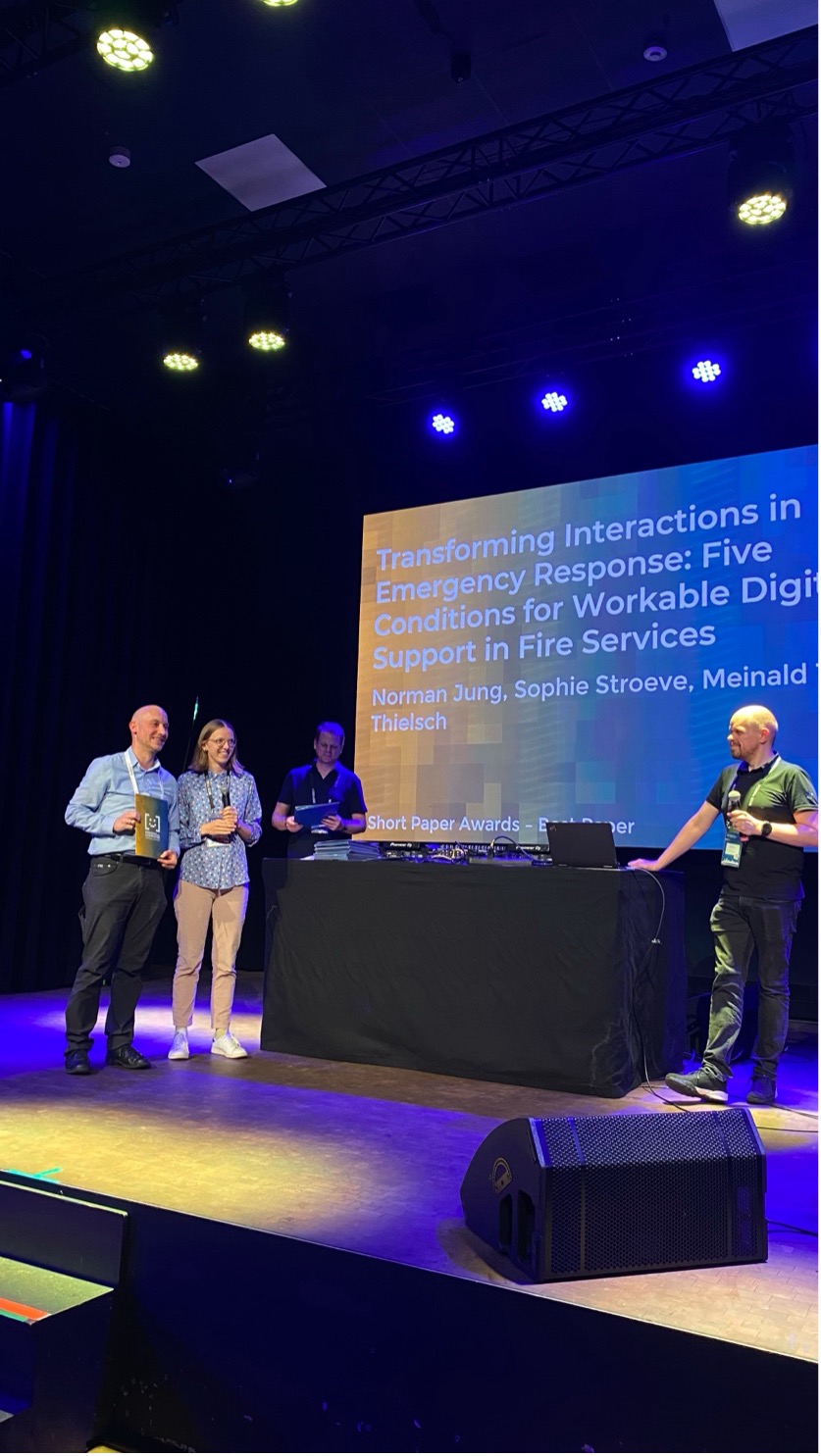
Norman Jung, Sophie Stroeve and Meinald Thielsch were presented with the Best Short Paper Award at the ‘Mensch und Computer 2026’ conference in Duisburg. Their interview-based study examines when digital support actually helps during fire service operations and when it lets its users down. The answer lies only partly in the device itself.
The paper, which received the award at ‘Mensch und Computer’ – the annual gathering of the German-speaking HCI community – begins with a question drawn from the day-to-day operations of fire services: does this digital tool still help when smoke obscures visibility, the radio is busy and every second counts? Drones, tablets, digital operational plans, robots, networked sensor systems and AI-supported systems are being used increasingly frequently by fire services and promise faster coordination, a better situational awareness or safer working conditions. However, their introduction often stalls or creates additional vulnerabilities at precisely the moment when they are actually supposed to provide greater operational capability.
For the study, 18 firefighters from ten federal states were interviewed; these had been selected from a previous online survey involving 410 participants. Twelve of them were active in voluntary fire brigades, three in professional fire brigades and three in both. A total of 1,452 individual statements were included in the qualitative content analysis, supplemented by 29 specific operational incidents. Examples included the use of a thermal imaging drone to assess a roof structure and digital hydrant maps during a vehicle fire outside built-up areas; conversely, a tablet that failed to provide the relevant vehicle information during an accident involving an electric vehicle, and a failed radio channel change during an industrial fire.
Five conditions for sustainable technology:
Across the various systems, respondents described technology as sustainable if it remained operable, understandable and supportive even under demanding operational conditions. This gives rise to five conditions: suitability for day-to-day operations; organisational prerequisites such as staffing, network coverage, maintenance and procurement; social integration within the team; a deliberately limited dependence on technology; and its introduction as a continuous process of adaptation.
The fourth point was particularly clear. The respondents welcomed technical support but warned against relying on it too heavily – not out of hostility towards innovation, but out of a sober practical logic: any system can fail, and a failure has the most serious consequences precisely when the system is needed most urgently. There were calls for explicit fallback options, including analogue ones, as well as training that maintains the ability to act without relying on digital systems. In this context, reliability does not simply mean that a system is running, but that the team can continue to work when it is not.
The article therefore views the introduction of technology not as an individual decision to adopt it, but as a socio-technical task: design, operational adaptation, organisational support, training and the management of failures are all interlinked, and none of these points is sufficient when considered in isolation.
The full publication is available here: doi.org/10.1145/3820253.3831378